Ruto Remains Non-Committal on Cabinet Reshuffle to Meet Two-Third Gender Rule
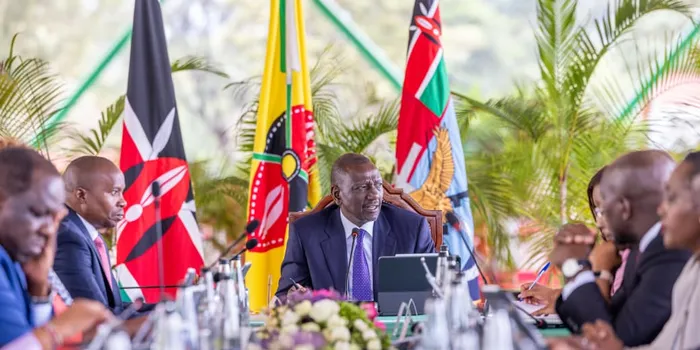
President William Ruto has remained non-committal on whether or not he is set to make changes to conform with a High Court ruling that gave him 120 days to meet the two-thirds gender rule. In his first public response, Ruto seemed to sidestep a question from Eric Latif of NTV about whether he would reorganise his Cabinet in accordance with the ruling and the Constitution. Speaking during the Katiba Day celebrations at the KICC in Nairobi, the Head of State said, “Just the same way the court has ruled that Parliament is not constitutional. That may not be achieved today, as it is a work in progress. Progressively, that is work in progress.”
Ruto instead appeared to refer to a similar ruling that directed the dissolution of Parliament during former President Uhuru Kenyatta’s administration, saying implementing such decisions could take time and would be achieved progressively. In July this year, a three-judge bench of the High Court dealt President Ruto a major legal setback after declaring that the current Cabinet violates the Constitution for failing to meet the two-thirds gender principle.
The judges ruled that the current composition of the Cabinet does not comply with Article 27(8) of the Constitution, which requires that no more than two-thirds of members of appointive public bodies be of the same gender. The court directed the President to reconstitute his Cabinet within four months, or 120 days, to ensure compliance, with Ruto now having only 42 days before the deadline expires.
The landmark judgment followed a petition filed by Katiba Institute, alongside the Centre for Rights Education and Awareness (CREAW), Transparency International Kenya, the Community Advocacy and Awareness Trust (CRAWN Trust), and the World March of Women-Kenya, who challenged the legality of the Cabinet constituted after the 2024 dismissals and subsequent appointments.
The bench comprising Justices Eric Ogola, Jairus Ngaah and Stephen Githinji found that the Executive had failed to satisfy the constitutional threshold on gender representation despite several rounds of Cabinet appointments and reshuffles. “The Cabinet, as constituted, fails the test of legality under Articles 152(1), 152(2) and Article 27(8) and is, therefore, invalid,” Justice Jairus Ngaah stated in the then ruling. Should Ruto proceed with the court order to reconstitute the Cabinet to meet the two-thirds gender rule, the move could trigger political tensions and cost some members of the current Cabinet their positions, with less than a year to the 2027 General Election.
The changes could also strain relations within the ruling Kenya Kwanza coalition and its partner, ODM, which is part of the broad-based government, according to political analysts. The possibility of a Cabinet reshuffle had already sparked political manoeuvring after the ruling, with ODM indicating that it was ready to propose some additional members for Cabinet positions. ODM Acting Secretary General Catherine Omanyo said in July that the party had several qualified women who could serve as Cabinet Secretaries should Ruto undertake a reshuffle.
This article was first published by Kenyans.co.ke
Image: FILE
Related Article