Film Bill expands state control at the expense of our liberties
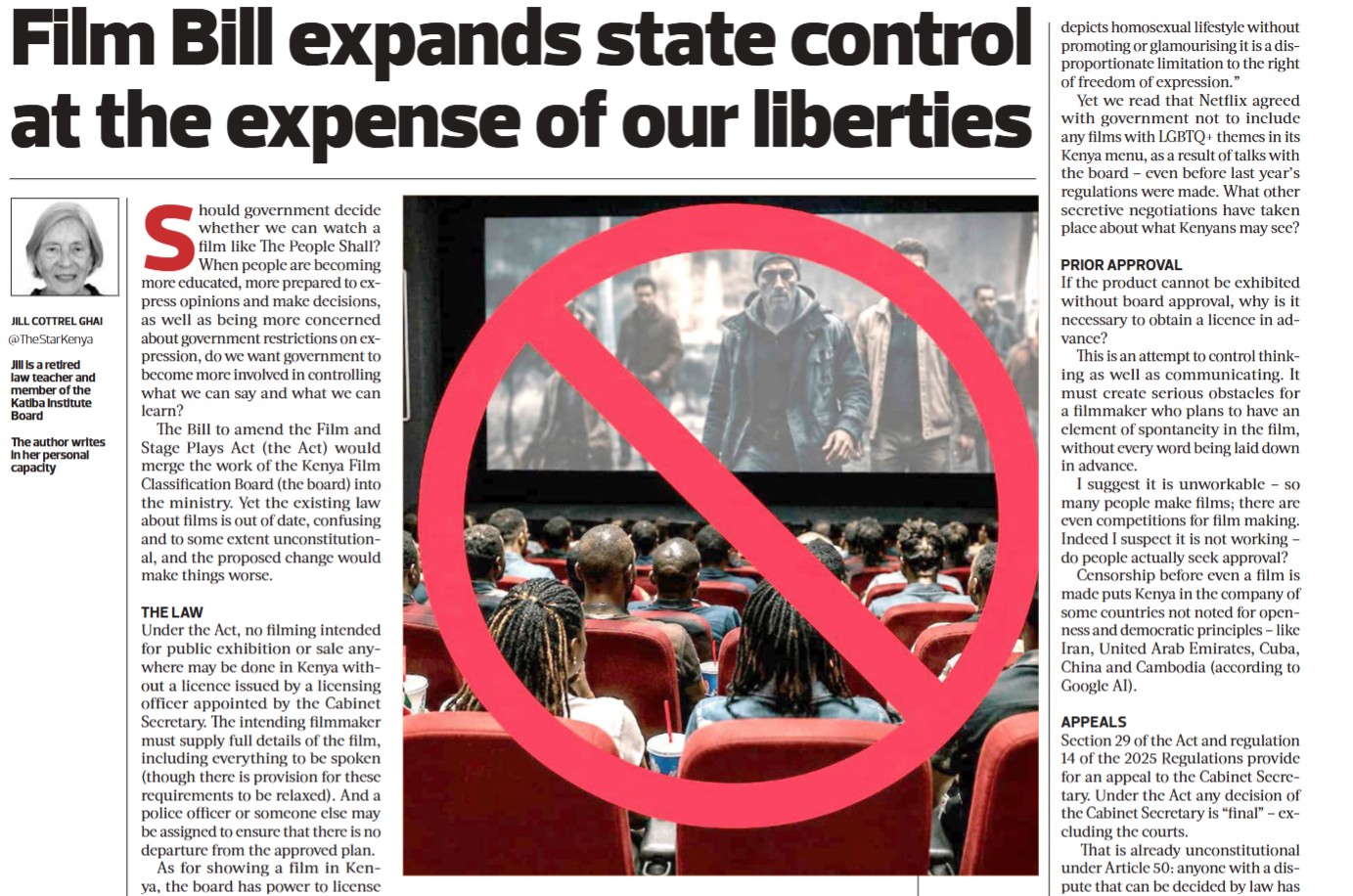
The People Shall
The Bill to amend the Film and Stage Plays Act (the Act) would merge the work of the Kenya Film Classification Board (the board) into the ministry. Yet the existing law about films is out of date, confusing and to some extent unconstitutional, and the proposed change would make things worse.
The law
Under the Act, no filming intended for public exhibition or sale anywhere may be done in Kenya without a licence issued by a licensing officer appointed by the Cabinet Secretary. The intending filmmaker must supply full details of the film, including everything to be spoken (though there is provision for these requirements to be relaxed). And a police officer or someone else may be assigned to ensure that there is no departure from the approved plan.
As for showing a film in Kenya, the board has power to license films to be shown only for certain age groups (“classification”) or even to refuse a licence completely. Since 2009 broadcasters must adopt the licensing decisions made by the board when they broadcast “cinematograph films”.
And no film (including any sort of audiovisual recording) may be distributed, exhibited or broadcast, unless the board has examined it and issued a certificate of approval.
Regulations made last year try to deal with some of the modern complexities. They cover “over the top” exhibitors, like Netflix, and video on demand such as YouTube, as well as broadcasters. These themselves must decide how any film material that they plan to show should be classified – “self-classification”. However, the board may override their decision and direct that such a film not be broadcast in Kenya, or be given a different classification for Kenyan purposes.
The criteria that are used for classification (or banning) are not clearly laid down by law, but by guidance developed by the board itself.
The board comprises 12 people, all appointed by the CS, including two Principal Secretaries and the board’s chief executive and eight others with some relevant qualification. No input into the CS’s decision as to membership is provided for.
Unconstitutionality
The obvious constitutional issue is freedom of expression under Article 33, which specifically recognises freedom of artistic creativity. This is not a matter of creators’ rights only. Every person has the right to seek and receive information or ideas (Article 33(1)(a)). It’s not the expression that worries those who seek to limit it – it is the impact the expression will have on those who hear, read, or otherwise receive it. Depriving people of the possibility of receiving information or ideas – or even of knowing that such information or ideas exist – should be kept to the absolute minimum.
And there is Article 34. It says law must provide for an agency to set “media” standards, which must be independent of control by government, political interests or commercial interests and reflect the interests of all sections of society.Even if “media” is assumed not to include cinema showings (which is not clear), television, and YouTube, are surely media – in which case the Board is already unconstitutional.
The constitutional umbrella of protection of expression does not cover propaganda for war, incitement to violence, hate speech, or advocacy of hatred (the constitution explains the last in detail).
There could, however, be limitations to the freedom of expression that is protected under the umbrella of Article 33. Any limitations must meet the requirements of Article 24. First limitations must be “by law” – and if law is vague the courts may hold that it is not law. The Act is remarkably unclear about the board’s functions: it must not approve a film that prejudices public order or offends decency, or the public exhibition or display of which would (in the board’s opinion) be undesirable in the public interest for any other reason. I suggest this might, in a properly argued case, be held to be too vague to be law.
Article 24 also says rights may be limited only if this is “reasonable and justifiable in an open and democratic society based on human dignity, equality and freedom.” And it includes as a criterion of acceptable limitations “whether there are less restrictive means to achieve the [legitimate] purpose”.
Furthermore: any provision in law made or amended after the constitution is invalid unless the law expresses the intention to limit a specific right or freedom, and is clear what the limitation are (Article 24(2)). So if this amending Bill is enacted – in its current form – the key provisions will be ineffective.
Secretive censoring
Recently the Court of Appeal said, in a case about the Kenyan film Rafiki, “outrightly banning a film that only depicts homosexual lifestyle without promoting or glamourising it is a disproportionate limitation to the right of freedom of expression.”
Yet we read that Netflix agreed with government not to include any films with LGBTQ+ themes in its Kenya menu, as a result of talks with the board – even before last year’s regulations were made. What other secretive negotiations have taken place about what Kenyans may see?
Prior approval
If the product cannot be exhibited without board approval, why is it necessary to obtain a licence in advance? This is an attempt to control thinking as well as communicating. It must create serious obstacles for a filmmaker who plans to have an element of spontaneity in the film, without every word being laid down in advance.
I suggest it is unworkable – so many people make films; there are even competitions for film making. Indeed I suspect it is not working – do people actually seek approval?
Censorship before even a film is made puts Kenya in the company of some countries not noted for openness and democratic principles – like Iran, United Arab Emirates, Cuba, China and Cambodia (according to Google AI).
Appeals
Section 29 of the Act and regulation 14 of the 2025 Regulations provide for an appeal to the Cabinet Secretary. Under the Act any decision of the Cabinet Secretary is “final” – excluding the courts. That is already unconstitutional under Article 50: anyone with a dispute that can be decided by law has a right to a fair and public hearing before a court or, another independent and impartial agency (maybe a tribunal) – not a CS.
Counties
Under the old Local Government Act it seems that local authorities had some power over what films were shown, though they could not approve one that the board had banned, or lower the age limit the board had set. Counties are responsible for cinemas and “video shows” (Fourth Schedule of the Constitution). These come under “Cultural activities, public entertainment”, suggesting that it includes some power over which films are shown in the county and to whom. It would be good to sort out what the powers of counties are.
The proposed amendment
The existing law includes knowledge of cinematography as a possible criterion for membership of the board. This might at least bring in some knowledgeable appreciation of the artistic side of filmmaking. Is there any guarantee that the ministry will be able to contribute such knowledge? Indeed one wonders who in reality would carry out the functions.
The whole idea of bringing films under a ministry will make violations of especially Article 33 and 34 even clearer than now. The constitution and the realities of modern film-making and exhibition make a fundamental rethink essential.
This article was first published by The Star Newspaper
Image: Newspaper Screenshot